
How Do Immigrants Help the Economy?

Immigrants are an important part of our economy. They bring unique skills, ideas, and perspectives to our work force. They assimilate faster, pay taxes, and help create businesses. This is a great benefit to both the native-born workers and to our economy as a whole.
Pay taxes
Paying taxes for immigrants is a vital contribution to the economy and the community. Immigrants are responsible for billions of dollars in tax revenues. They help fund public services such as schools and medical facilities. However, many immigrants do not pay their fair share.
During his State of the Union speech, President Donald Trump claimed that unauthorized immigrants are a burden to US taxpayers. Whether or not he is correct, there is no denying that immigrants contribute to the U.S. economy.
Immigrants are also a major contributor to state and local governments. In California, immigrants paid 28 percent of all taxes. Similarly, in Texas, immigrants contributed $12 billion. These figures are estimated by the Institute on Taxation and Economic Policy.
Immigrants’ contributions also spur job creation. Studies have shown that immigrants frequently use their spending power to purchase goods and stimulate local business activity. By creating demand, foreign tax revenue creates jobs. Furthermore, the money goes back into the economy and creates more jobs for U.S.-born workers.
Several studies have found that immigrants have a net positive effect on the financial status of public programs. For example, immigrants are expected to contribute $2.0 trillion in net benefit to Social Security by 2072. This helps to ensure the long-term solvency of the program.
Undocumented immigrants may be able to pay their taxes by using a false social security number. Alternatively, they can file their taxes using an Individual Tax Identification Number. However, undocumented workers are not eligible for the Earned Income Tax Credit or state EITCs.
Undocumented immigrants’ income is usually below the legal minimum to qualify for certain public benefits. However, they are likely to have more income when they become naturalized. Moreover, they may even benefit from paying income taxes when they become citizens.
It is important to recognize that many people are paying their state taxes without realizing it. It is good to pay taxes, because it shows your moral character. Also, it can affect immigration legislation. If you are an unauthorized immigrant, you may need an accountant or an immigration attorney to help you navigate the intricacies of the tax code.
Assimilate faster
According to a recent study, immigrants are assimilating faster than they used to. In fact, a newcomer’s first year earnings were nearly twice what they made at age 18. However, that isn’t to say that immigrants don’t have the right to try to reclaim their homelands.
In fact, researchers say they have found immigrants are more likely to be happy in the states than in their native country of origin. But how can we explain this? Well, the answer lies in a confluence of factors, both economic and political. Specifically, the United States has a number of entrants with differing languages and cultures. For example, immigrants from Latin America are more likely to speak Spanish than their native tongue. A recent study suggests that the differences between immigrants of different linguistic persuasions may be a factor of as many as seven. The study also posits that if newcomers to the state have a large social network and a healthy dose of civic piety, they are more likely to adapt to their new surroundings than those who have a tighter grip on their new home.
Researchers at the University of Maryland have shown that assimilation is most likely to take place in communities with robust social networks, and a few well-placed incentives. They have found that incentives such as language and cultural orientation programs paired with economic ones, such as low-interest loans and employment benefits, have resulted in higher rates of assimilation.
Complement native-born workers
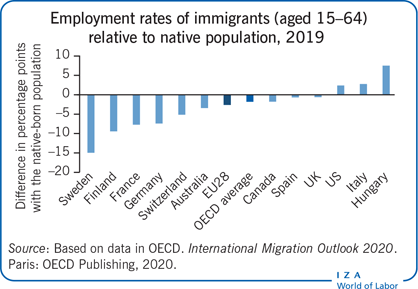
Immigrants and native-born workers in the economy complement each other in many ways. They work in the same occupations, but they are also a complement to each other in a variety of different skill sets. This is important to consider when comparing the wages of immigrants to those of native-born workers.
Studies on the effects of immigration have typically looked at the average wage of a group of natives, rather than the differences in wages among individual workers within the group. Although there is some evidence to suggest that the overall wage distribution is positively affected by immigration, there is a much more nuanced picture.
For instance, studies have shown that high-skilled immigration boosts the wages of both college-educated and non-degree workers. However, they have found that these gains are larger for college-educated workers than for non-degree workers.
In the United States, more than two-thirds of adults aren’t high-school graduates. While many immigrant workers are low-skilled, they are also highly educated. College-educated females earned more than three times the average weekly wage of non-degree workers in 2007.
While the wage benefits of immigrant labor have been studied extensively in the literature, little has been said about its impact on the overall distribution of wages. In fact, some studies show that the wages of immigrants are actually lower than those of their U.S. counterparts.
High-skilled immigrants enter the economy through formal channels, and they tend to have a higher concentration in jobs in the primary sector. A net inflow of high-skilled workers can boost the supply of low-skilled native-born workers, increasing their employment opportunities.
The adverse effect of low-skilled immigrants on native-born workers has been the subject of numerous studies, but there is little consensus on the magnitude of these effects. One study, for example, found that immigration has a small but negative effect on the wages of native-born workers, primarily in the lower-wage end of the wage spectrum.
High-skilled immigrants are expected to have a larger impact on the wages of native-born workers than low-skilled immigrants. Moreover, research suggests that high-skilled immigrants can promote certain economic activities. Information technology, for example, may be promoted by immigrants.
Start a firm
Immigrants start businesses in the United States more than native born Americans, and these firms contribute to economic growth. In many states, first- and second-generation immigrants create forty percent of new businesses. These entrepreneurs also contribute to innovation. Many immigrant businesses provide ongoing jobs to 16 million people.
An immigrant business is more likely to be unsuccessful than a native-owned firm. Moreover, these businesses do not provide as much benefit to their employees as native-owned firms do. Despite the positive contributions of immigrants, the legal barriers to immigrant entrepreneurship cause lost growth and innovation in the U.S. and abroad.
The study found that immigrants have contributed to the success of Fortune 500 companies. For instance, Elon Musk, a South Africa native, started the Telsa plant in California, which employed 50,000 people. He also injected $4.1 billion into the California economy in 2017. And, in North Dakota, immigrants created five percent of the new businesses in that state.
Immigrant entrepreneurs also have a higher rate of startup capital than their non-immigrant counterparts. Twenty-percent of immigrant businesses start with at least $50,000 in capital. This is compared with 15.9 percent of non-immigrant businesses.
Immigrants are also more likely to receive patents. In fact, the average number of patents granted to immigrant-founded firms is 35 percent higher than to native-founded firms. Furthermore, immigrant-founded firms are more engaged in international trade than their native counterparts.
Immigration reform is needed to capture the economic benefits of immigrants. However, we also need ways to enhance the economic outcomes of low-skilled workers in our increasingly skill-intensive economies. Currently, immigrants make up about 15 percent of the working population in the United States. By expanding immigration, we can moderate the effects of the aging population and improve long-term economic growth. To do this, we need to develop effective entry programs for immigrants.
Immigrant entrepreneurship is an important way to improve the performance of the immigrant labor market. It can also help to alleviate poverty in the country. There is a growing body of literature on this topic. If you are an entrepreneur, check out the Mosaic Project to get connected to networks that can help you through the process.