
How Do Illegal Immigrants Pay Taxes Without Social Security Number?

The first thing that you should do to pay taxes is to get an Individual Taxpayer Identification Number (ITIN). You should also get a Form I-9. You should also try to get the Earned Income Tax Credit. If you are eligible for EITC, you can get a tax refund.
Form I-9
If you’re a foreigner who has entered the United States illegally, you may not have a Social Security number. In this situation, you will have to fill out a form, known as Form I-9, to prove that you are authorized to work in the US. Several documents are required to complete the form, and it’s possible to find yourself in trouble if you don’t know what you’re doing.
Fortunately, there are several options available to you to help you fill out your form and get the information you need. Some of these options include applying for an Individual Taxpayer Identification Number (ITIN) and paying taxes. Both of these steps are designed to help you pay your tax bill and show that you are a law-abiding, U.S. citizen. Whether you apply for an ITIN or a Social Security number, you will need to provide some biographical information, such as your name, address, and date of birth.
You can file for an ITIN by sending your identification documents to the IRS. The process will take between seven and eleven weeks, depending on the agency. Before you begin, make sure you have a copy of your tax return to submit with the form.
To complete Form I-9, you’ll need to provide your full name, your date of birth, and your social security number. Your biographic information will also include your immigration status and address. After you’ve completed the form, you’ll need to sign it. Finally, you’ll have to provide the information for your contact phone number and email.
Several types of identification documents are accepted on the form. These documents include a passport, a driver’s license, or a school ID card with a photograph. Depending on the employer, you might be asked to provide two or three different documents.
Once you’ve completed the form, you’ll want to retain it for at least a year. If you’ve hired someone recently, you’ll need to keep the form until that person leaves your company. Regardless of the length of time you choose to keep the form, you’ll have to re-verify it periodically to ensure that it’s valid. This is to ensure that you are not hiring an unauthorized worker. It’s also to avoid any potential legal ramifications.
During the administrative inspection process, the Immigration and Customs Enforcement (ICE) agency will determine whether the documents you have on hand are valid for employment. If they are not, you’ll receive a Notice of Inspection, also known as a Compliance Letter. ICE will advise you of any civil or criminal penalties that you might incur for failing to produce a valid Form I-9.
If you fail to re-verify your employee’s work authorization, you’ll be considered knowingly employing an unauthorized worker. This is an important consideration, as the penalties for unauthorized employment are severe.
Individual Taxpayer Identification Number (ITIN)
The Individual Taxpayer Identification Number (ITIN) is a nine-digit identification number assigned by the Internal Revenue Service to certain foreign nationals to help with tax purposes. Although it does not provide legal immigration status, it is an important tool for some foreign workers in the U.S. During the years when they do not have access to a social security number, an ITIN will help them pay taxes. This is a way for them to participate in the financial system and build their credit.
The individual’s work history, which is shown on the ITIN, is useful in establishing their legal residency in the U.S. It can also be used to apply for a driver’s license or bank account. In addition, the ITIN can help an individual in other areas, such as gaining temporary immigration status.
In recent years, the Internal Revenue Service has made a change to their policy on the use of the ITIN. They have limited the types of documentation that may be submitted with an application. Therefore, it is more difficult for eligible individuals to obtain an ITIN. Applicants must provide proof of identity and proof that they are not a resident alien in the United States. A variety of documents can be submitted with an application, but some of the most common are a photo ID, unexpired birth certificate, school records, and an employment authorization form.
If you are an undocumented worker and are unable to complete your own tax return, you can contact a professional like a tax specialist to assist you. You can also check out the Low Income Taxpayer Clinics in your area. These clinics will help you find an Acceptance Agent, a person or organization that is authorized by the IRS to assist with the application process.
An applicant for an Individual Taxpayer Identification Number will receive a letter containing a nine-digit ITIN. The ITIN will not provide legal immigration status, but it can be an alternative to a social security number. For some, it will give them a sense of belonging. Others view filing taxes as a means to demonstrate their economic contribution to the country.
To apply for an ITIN, you must submit an application form known as Form W-7. It is available online and at local IRS offices. All documents that are presented to the IRS must be original. However, it is recommended that you use a certified copy.
When completing the form, you must include a letter explaining why you are applying for an ITIN. You can also include copies of your passport and visa. Alternatively, you can choose to apply by mail. After you complete the form and send it in, you can expect to receive a letter containing the ITIN within a few days.
Earned Income Tax Credit (EITC)
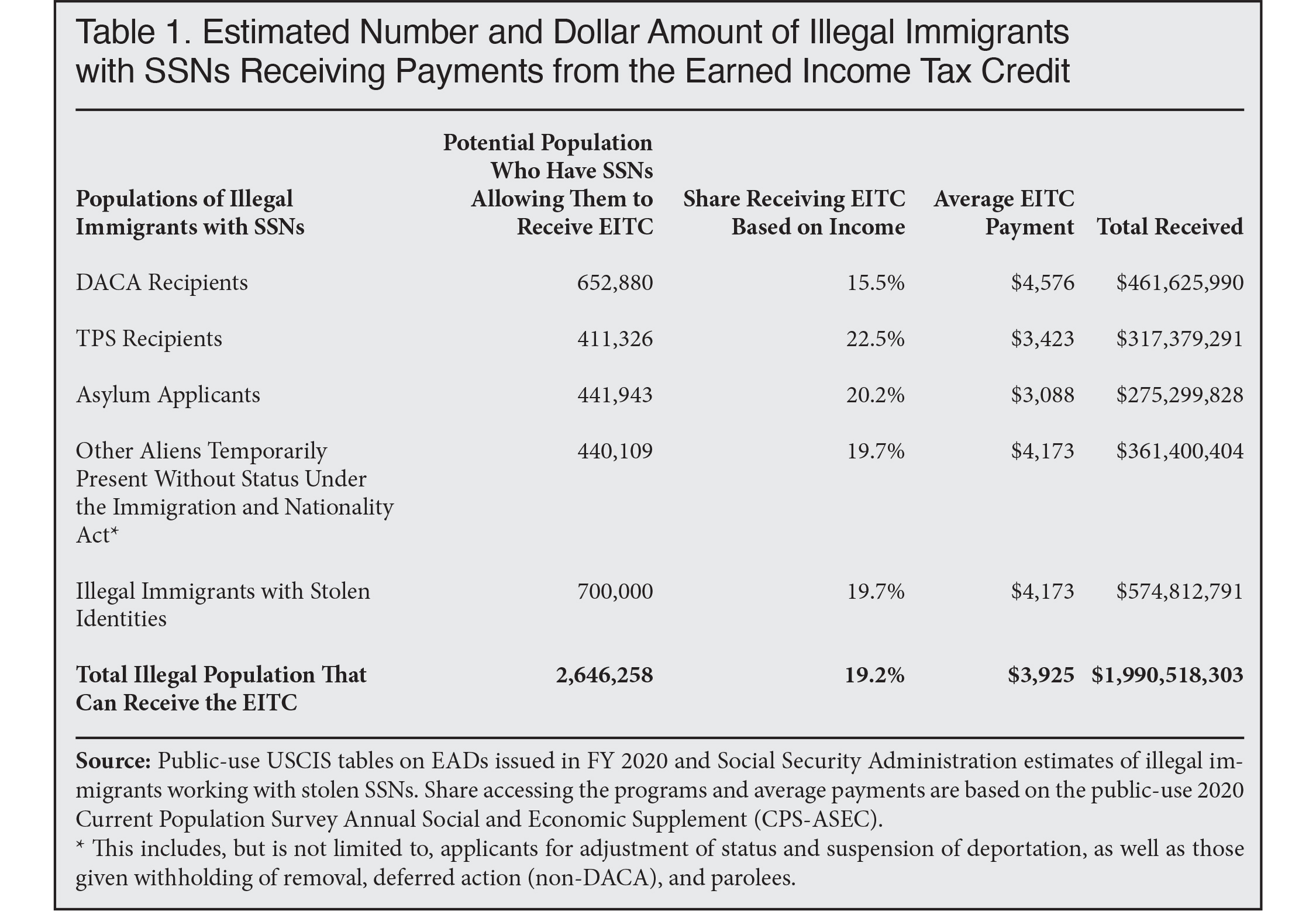
The EITC (Earned Income Tax Credit) helps low-income families meet the basic necessities of life, including food, shelter, and child care. It can be claimed by filing a tax return. Generally, it is issued within three years of the end of the tax year. A valid Social Security number is required. Currently, only children with a valid SSN can claim an EITC payment.
While the federal Earned Income Tax Credit is meant to benefit financially vulnerable communities, it also provides a strong incentive to work. In fact, the EITC is designed to help the lowest-wage workers earn more credit with every dollar they earn. Workers with children can earn as much as $6,728 in 2014.
However, in order to qualify for EITC, a worker must have a valid SSN and must have lived in the United States for the past six months. Unfortunately, many undocumented workers do not have a SSN, and so they are not able to claim the EITC. Fortunately, the IRS has ruled that individuals in the country illegally who receive the President’s action can claim the EITC for up to three years, providing an avenue for some to earn extra money. This is a dispensation granted by Congress.
However, despite this leniency, there are still barriers that prevent the vast majority of immigrant families from accessing the EITC. Some of these barriers include the absence of an ITIN, which is a valid SSN. There are several ways to overcome this obstacle, however. An important step is to educate the public about the Earned Income Tax Credit. Those who are concerned about this issue can contact their congressional representative.
In addition to providing support for migrant families, the EITC can help taxpayers who are self-employed. For example, it can help those who are unemployed pay for food, rent, and child care. Those who qualify for the credit also have the opportunity to receive other benefits, such as SSI and Medicaid.
As a result of the COVID-19 pandemic, policymakers have demonstrated a renewed interest in expanding access to benefits for the nation’s nonfilers. To that end, several states have introduced eligibility expansions for the EITC. Colorado, for example, recently expanded its EITC to include workers who file an ITIN. Similarly, New Mexico has proposed similar expansions. And a new study by the Institute on Taxation and Economic Policy suggests that 2.4 million immigrant families could have received the EITC.
These findings suggest that information and outreach can increase equitable receipt of tax benefits. But a reliable data set is needed to understand how EITC recipients fare across socioeconomic characteristics. One of the most promising approaches involves creating clear messaging in readily-accessible languages. Another approach is to make the tax filing process more convenient. Increasing the number of EITC filers who can complete their returns in their own language may be effective.